
If you run a local business, showing up on Google at the right time can mean the difference between gaining a new customer or losing them to a competitor. That’s exactly where Local SEO (Search Engine Optimization) comes in.
In this blog, we’ll cover everything you need to know—from how local SEO works, the key ranking factors, and step-by-step strategies, to the tools you can use, common challenges, and even future trends. By the end, you’ll have a complete Local SEO checklist to help your business rank higher locally, attract more nearby customers, and grow faster.
What is Local SEO and Why Does It Matter?
Local SEO means optimizing your business’s online presence to attract more customers from relevant local searches on Google and other search engines.
Whenever someone searches for services or products “near me” or includes a location (like “best salon in Noida” or “pizza delivery near Connaught Place”), Google shows results based on proximity, relevance, and prominence.
Example: A Delhi-based dental clinic, Clove Dental, increased its local appointments by over 40% by optimizing Google Business Profiles across all its branches with consistent NAP details and collecting reviews at scale.
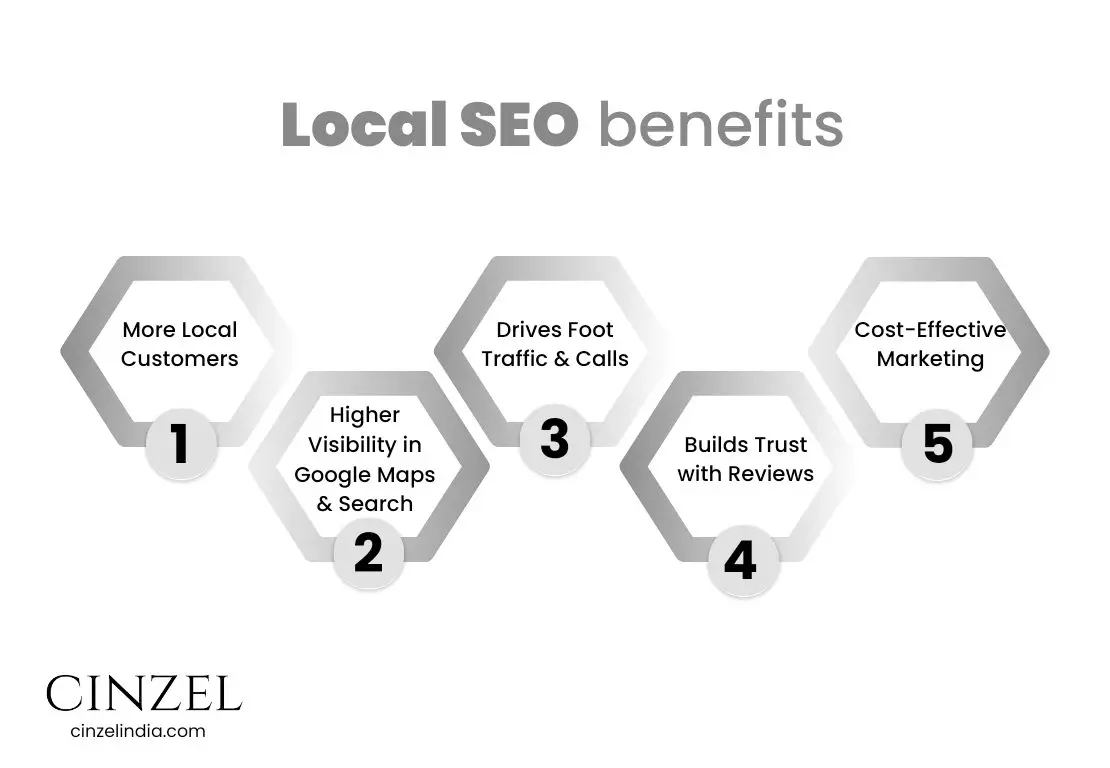
Local seo benefits -
-
-
More Local Customers
Over 46% of all Google searches are local. If you’re not optimizing, you’re missing out on potential nearby customersExample: A Lucknow-based café saw a 25% increase in walk-ins after ranking for “best café near Hazratganj.
-
Higher Visibility in Google Maps & Search
An optimized Google Business Profile ensures your business shows up when people search for services like yours . An optimized Google Business Profile ensures your business shows up when people search for services like yours.
Example: A chain of gyms in Mumbai optimized its GBP with photos and updates and started showing up for “best gym in Andheri. -
Drives Foot Traffic & Calls
Local SEO increases “call now” clicks, direction requests, and actual visits to your store or office.
Example: A salon in Gurgaon received 300+ direction requests per month after optimizing local search. -
Builds Trust with Reviews
Customer reviews and ratings improve credibility, making people more likely to choose your business
Example: A Jaipur-based restaurant doubled its bookings after hitting 500+ Google reviews with a 4.7 rating. -
Cost-Effective Marketing
Unlike paid ads, Local SEO brings long-term visibility and steady customer flow without recurring ad spend.
-
How Local SEO Works?
Local SEO helps search engines like Google recognize who you are, what services you provide, and where you’re located, so your business appears in nearby searches.
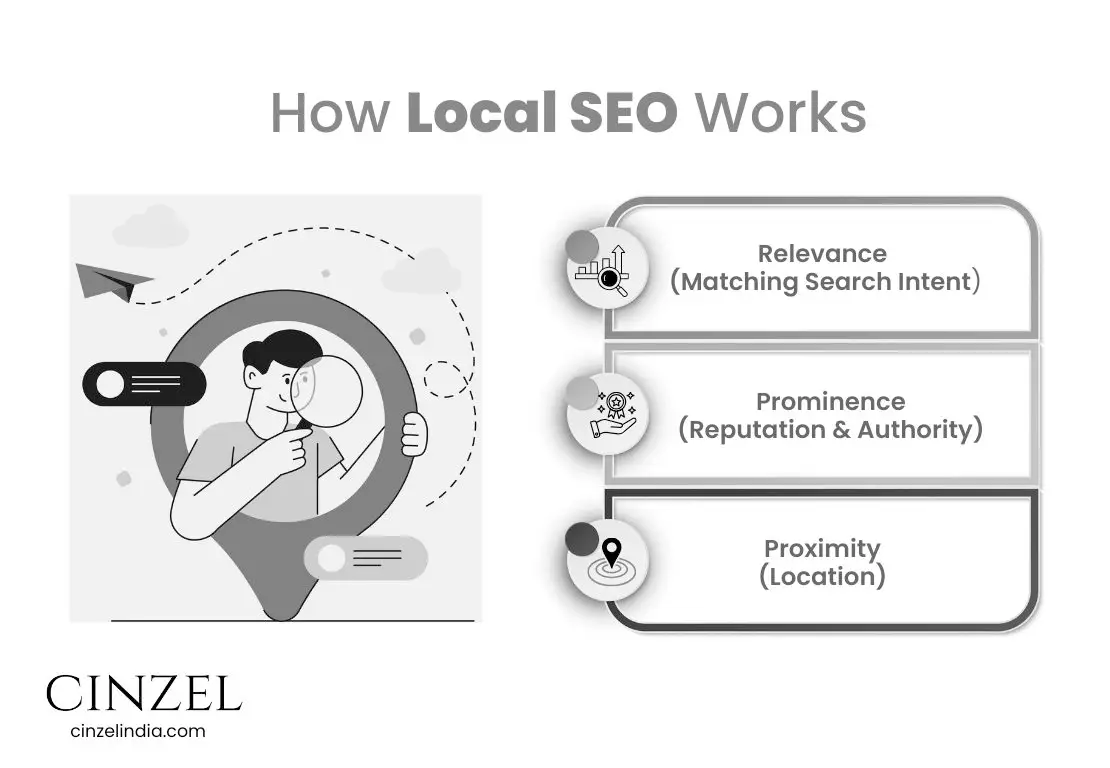
When someone searches “best dentist near me” or “mobile repair shop in Noida,” Google’s algorithm considers three main things:
Proximity (Location)
How close your business is to the searcher.
Example: If someone in Sector 18 Noida searches “coffee shop near me”, Google will show coffee shops closest to that area.
Relevance (Matching Search Intent)
How closely your business aligns with the user’s search intent.
Example: If you own a bakery and your Google Business Profile says “cakes, pastries, birthday cakes,” you’re more likely to show up when someone searches “birthday cake shop near me.”
Prominence (Reputation & Authority)
How reputable and trustworthy your business appears across digital and real-world spaces.
Factors include Google reviews, ratings, backlinks, local citations, and mentions across the web.
Key Elements That Make Local SEO Work
-
- Google Business Profile (GBP): Claiming and optimizing your profile with correct name, address, phone number (NAP), business hours, photos, and services.
- Citations & Directories: Listing your business on trusted sites (Justdial, Sulekha, Yelp, IndiaMart, etc.) with consistent details.
- Customer Reviews: A higher number of positive reviews boosts your chances of showing up in the local search pack.
- On-Page SEO: Using local keywords, schema markup, and location-based content helps optimize your website for nearby searches.
- Backlinks: Earning links from local blogs, news outlets, or business associations strengthens your authority and visibility.
Core Ranking Factors of Local SEO (Must Have)
Google relies on key ranking signals to decide which businesses appear first in local searches. To rank higher in the local pack (Google Maps 3-pack) and organic results, you need to optimize these core factors:
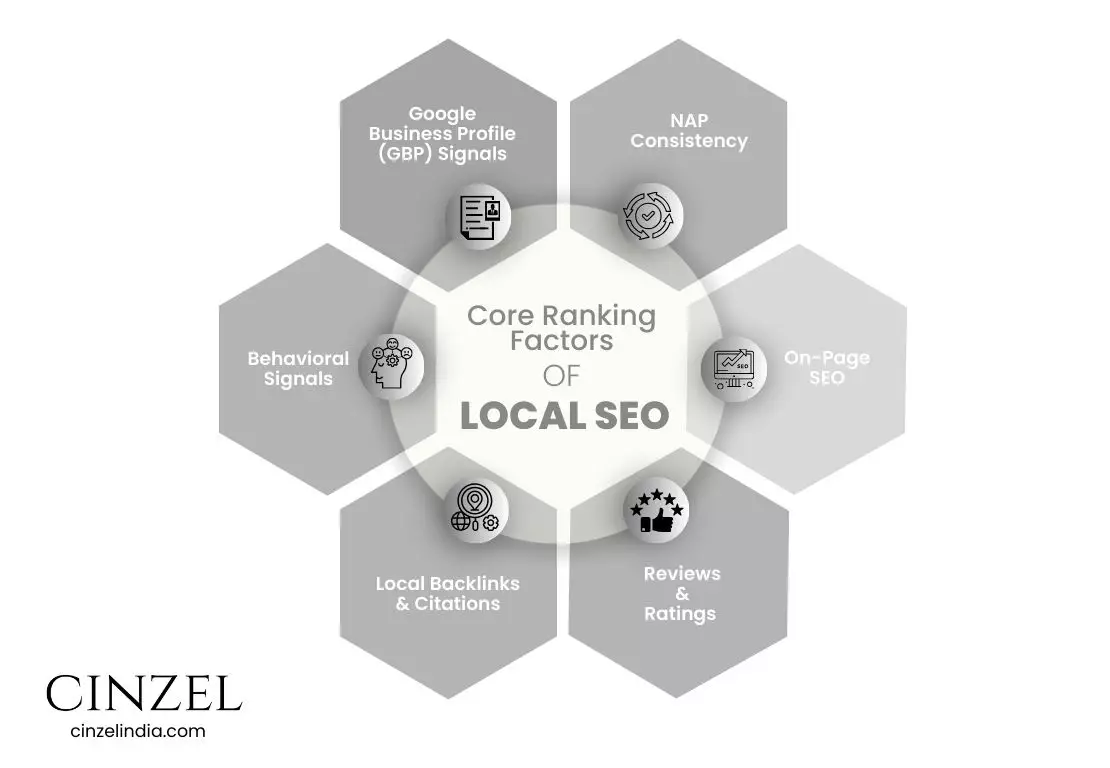
These are the signals Google relies on to decide which local businesses deserve top visibility:
- Google Business Profile (GBP) Signals – Completeness, relevance, keywords, and frequent updates.
- NAP Consistency – Your Name, Address, and Phone number must match everywhere online.
- Reviews & Ratings – Volume, recency, and quality of reviews build trust.
- Local Backlinks & Citations – Links and mentions from authoritative, locally relevant sites.
- On-Page SEO- Optimizing your website with location-specific keywords, title tags, meta descriptions, and schema markup to help search engines better understand your business.
- Behavioral Signals – Click-through rates, calls, and map directions that show user engagement.
Winning Local SEO Strategy 2025: Step-by-Step Guide for Small Businesses
To make your business visible in local searches and on Google Maps, implement these essential Local EO strategies:
Step 1: Set Up & Optimize Your Google Business Profile (GBP)
Claim your business on Google Business Profile.
Provide complete business details – Include your business name, category, address, phone number, website, and operating hours.
Upload high-quality photos (logo, interior, team, products).
Add services, products, FAQs, and regular updates/posts.
Encourage customers to leave reviews.
Step 2: Ensure NAP Consistency Everywhere
Your Name, Address, Phone Number (NAP) must be exactly the same across:
Your website
Business directories (Justdial, IndiaMart, Yelp, Sulekha, etc.)
Social media pages
Even small spelling or format changes can hurt rankings.
Step 3: Optimize Your Website for Local SEO
Add local keywords (e.g., “salon in Noida Sector 18,” “plumber near Connaught Place”).
Create location-specific pages if you serve multiple areas.
Implement Local Schema Markup – Add structured data to your site so Google clearly understands your business type, services, and location.
Add a Google Map embed on your contact page.
Step 4: Build Local Citations
List your business on trusted directories and platforms like:
IndiaMart, Justdial, Sulekha, Yellow Pages, Yelp, Clutch, etc.
Ensure NAP consistency in all listings.
More citations = stronger trust signal for Google.
Step 5: Collect & Manage Reviews
Ask happy customers to leave Google reviews.
Respond politely to both positive and negative reviews.
Add reviews/testimonials on your website for credibility.
Step 6: Get Local Backlinks
Collaborate with local bloggers, newspapers, and community sites.
Sponsor local events or partner with other businesses for cross-links.
High-quality local backlinks boost your prominence factor.
Step 7: Leverage Social Media & Local Content
Share updates, offers, and events on social media.
Create blogs or content around local topics (e.g., “Top 5 Cafes in Noida” if you’re a cafe).
More engagement = stronger local relevance.
Step 8: Track & Measure Results
Use Google Business Profile Insights for calls, direction requests, and views.
Track website visits with Google Analytics & Search Console.
Use tools like Moz Local, BrightLocal, or SEMrush to monitor rankings.
Common Problems You Might Face in Local SEO
- Inconsistent NAP – Different name, address, or phone across directories.
- Duplicate Listings – Multiple Google Business Profiles or directory entries.
- Few or Negative Reviews – Lack of trust-building signals.
- Wrong Business Category – Choosing irrelevant or broad categories.
- Weak Website Optimization – No local keywords, slow, or not mobile-friendly.
- Missing Local Citations/Backlinks – Not listed on trusted local directories.
- Outdated Google Business Profile – Old hours, missing photos, or no posts.
- Proximity Limitations – Ranking drops when searchers are farther from your location.
Local SEO Tools and How Results Can Be Measured
To succeed with Local SEO, you need the right tools to manage your listings, track rankings, and measure performance. Here are the must-haves:
Top Local SEO Tools
-
-
Google Business Profile (GBP) – Manage your business listing, posts, reviews, and insights.
-
Google Analytics – Track website visits, calls, and conversions from local searches.
-
Google Search Console – Monitor local keyword performance and website visibility.
-
Moz Local – Helps manage citations and ensures NAP consistency.
-
BrightLocal – All-in-one tool for local rank tracking, citations, and review monitoring.
-
SEMrush / Ahrefs – Track local keyword rankings, backlinks, and competitor analysis.
- Whitespark – Great for finding citation opportunities and managing local links.
-
How to Measure Results
-
-
Google Business Profile Insights
Track calls, direction requests, website clicks, and profile views. -
Keyword Rankings
Monitor where you rank for local keywords (“best salon in Noida”). -
Website Traffic
Check local organic traffic in Google Analytics. -
Conversions & Engagement
Number of calls, form fills, bookings, or in-store visits from search. -
Review Growth
Track new reviews, star ratings, and response rate.
-
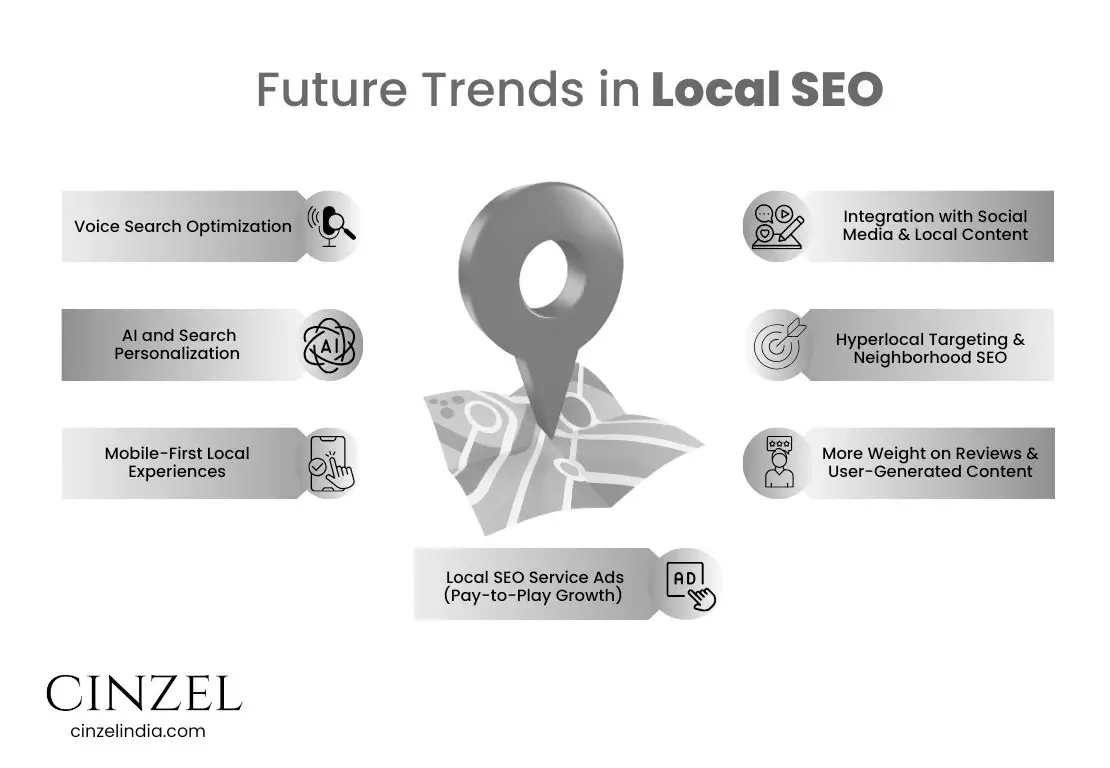
Future Trends in Local SEO
Local SEO is constantly evolving as Google updates its algorithms and user behavior changes. To stay ahead, businesses need to prepare for these upcoming trends:
-
Voice Search Optimization
More people are using voice assistants (“Hey Google, find a plumber near me”).
Businesses will need to optimize for conversational, long-tail queries and FAQs. -
AI and Search Personalization
Google’s AI (like Gemini and SGE) is making search more personalized.
Local results will adapt based on user intent, preferences, and history. -
Mobile-First Local Experiences
Since most local searches happen on mobile, fast, mobile-friendly websites are critical.
Features like tap-to-call, chat support, and map integration will matter even more. -
Local SEO Service Ads (Pay-to-Play Growth)
Google’s Local Service Ads are expanding, meaning some visibility may require paid promotion.
Businesses that combine SEO + local ads will gain a competitive edge. -
More Weight on Reviews & User-Generated Content
Star ratings, detailed reviews, and even photos uploaded by customers will carry more ranking power.
Reputation management will be a core part of Local SEO. -
Hyperlocal Targeting & Neighborhood SEO
Google is narrowing results to specific neighborhoods and micro-locations.
Businesses should optimize content for very specific areas (e.g., “Salon in Indirapuram Ghaziabad” instead of just “Salon in Ghaziabad”). -
Integration with Social Media & Local Content
Social signals (engagement on Instagram, Facebook, etc.) may influence local visibility.
Locally relevant blog posts, reels, and community-driven content will help rankings
Checklist: Everything You Need to Rank Locally
-
Claim and fully optimize your Google Business Profile with accurate details, categories, and photos.
-
Ensure your NAP is consistent across your website, directories, and social media.
-
Ask happy customers to leave authentic Google reviews and respond to them.
-
Build local backlinks by joining chambers of commerce, sponsoring events, or collaborating with local blogs.
-
Add location keywords (e.g., “best café in Noida”) to your site’s titles, meta descriptions, and content.
-
Use local schema markup so Google easily understands your business location.
Local SEO Tips to Boost Your Local Rankings
-
Optimize Google Business Profile → Keep your business info accurate, add photos, and update regularly.
-
Use Local Keywords → Add city or area-specific keywords in titles, meta, and Content.
-
NAP Consistency → Ensure your Name, Address, Phone number are consistent across all platforms.
-
Get Local Backlinks → Partner with local bloggers, newspapers, or community websites.
-
Collect Reviews → Encourage customers to leave positive Google reviews and respond to them.
-
Mobile Optimization → Make your website mobile-friendly for on-the-go local searches.
-
Add Location Pages → If you have multiple branches, create separate optimized pages for each.
-
Engage on Social Media → Share local content, events, and offers to increase visibility.
-
Use Schema Markup → Add Local Business schema to help Google understand your business better.
- Track & Measure → Monitor insights from Google Business Profile, Google Analytics, and tools like SEMrush or BrightLocal.
Conclusion: The Road to Local Visibility
In today’s digital-first world, Local SEO isn’t just an option—it’s a necessity for any business that wants to attract nearby customers and stay competitive. By following the checklist, optimizing for core ranking factors, and keeping up with future trends, you can ensure your business shows up exactly where your audience is searching. Start implementing these strategies today, and watch how Local SEO helps you drive more traffic, build trust, and grow your business locally.
Quick Answers to Common Local SEO Queries
What is Local SEO and how is it different from regular SEO?
Local SEO focuses on optimizing your business for searches in a specific geographic area, while regular SEO aims to improve visibility on a national or global level.
How can Local SEO help my small business get more customers?
Local SEO makes your business appear in local search results and Google Maps, helping nearby customers find you quickly and increasing walk-ins or local leads.
Do I need a physical store to benefit from Local SEO?
Not necessarily. Even service-based businesses without a storefront (like plumbers or consultants) can use Local SEO to attract clients in their service area.
How long does it take to see results from Local SEO?
Most businesses start noticing improvements within 3–6 months, depending on competition, consistency, and strategy.
Is Google Business Profile really necessary for ranking locally?
Yes! A well-optimized Google Business Profile (formerly Google My Business) is one of the strongest ranking factors for local searches.
What kind of businesses benefit the most from Local SEO?
Any business that serves customers in a specific location—restaurants, salons, gyms, clinics, retail shops, or local service providers—benefits greatly from Local SEO.
Can I do Local SEO myself or should I hire an agency?
You can handle the basics yourself (Google Business Profile, reviews, citations). But for advanced results, an agency can save time and maximize growth.
How much does Local SEO cost for small businesses?
It varies—basic DIY efforts may cost almost nothing, while professional Local SEO services can range from ?10,000–?50,000 per month depending on scope and competition.
Do online-only businesses need Local SEO?
If you don’t serve a specific location and operate fully online, you’ll benefit more from traditional SEO than Local SEO.
What are the most common mistakes businesses make in Local SEO?
Ignoring reviews, inconsistent NAP (Name, Address, Phone) details, and failing to update Google Business Profile are the biggest mistakes.
Do I need a physical store?
A service-based business like UrbanClap (now Urban Company) ranks locally without a storefront.
How do customer reviews affect my Local SEO rankings?
Positive, frequent, and authentic reviews boost trust and visibility. They’re a direct ranking factor for local search results.
Can social media improve my Local SEO visibility?
Indirectly, yes. Active social media builds brand awareness, drives traffic, and increases engagement—all of which support Local SEO.
How do I track the success of my Local SEO efforts?
You can use tools like Google Analytics, Google Search Console, and Google Business Profile Insights to measure clicks, calls, visits, and rankings.
What’s the difference between Local SEO ranking factors and organic SEO ranking factors?
Local SEO focuses heavily on proximity, relevance, and reviews, while organic SEO is more about content, backlinks, and website authority.
Will voice search impact Local SEO in the future?
Absolutely! With the rise of voice assistants, optimizing for conversational queries like “near me” searches is becoming more important.
