
As a digital marketing agency in Noida, we often hear the same frustration from growing businesses: content is published consistently, yet traffic stays flat and rankings don’t improve. Blogs are written, pages are indexed, and social posts are shared, but visibility doesn’t scale the way it should. In a search environment increasingly influenced by AI-driven results, publishing content alone is no longer enough. What businesses need today is a smarter, performance-led approach where content is built to learn from user behavior and adapt over time through modern AI SEO strategies.
Understanding the AI SEO Content Loop
Most content strategies follow a linear process:
Write → Publish → Repeat
Once a post goes live, it’s rarely revisited.
Insights are lost. Mistakes are repeated.
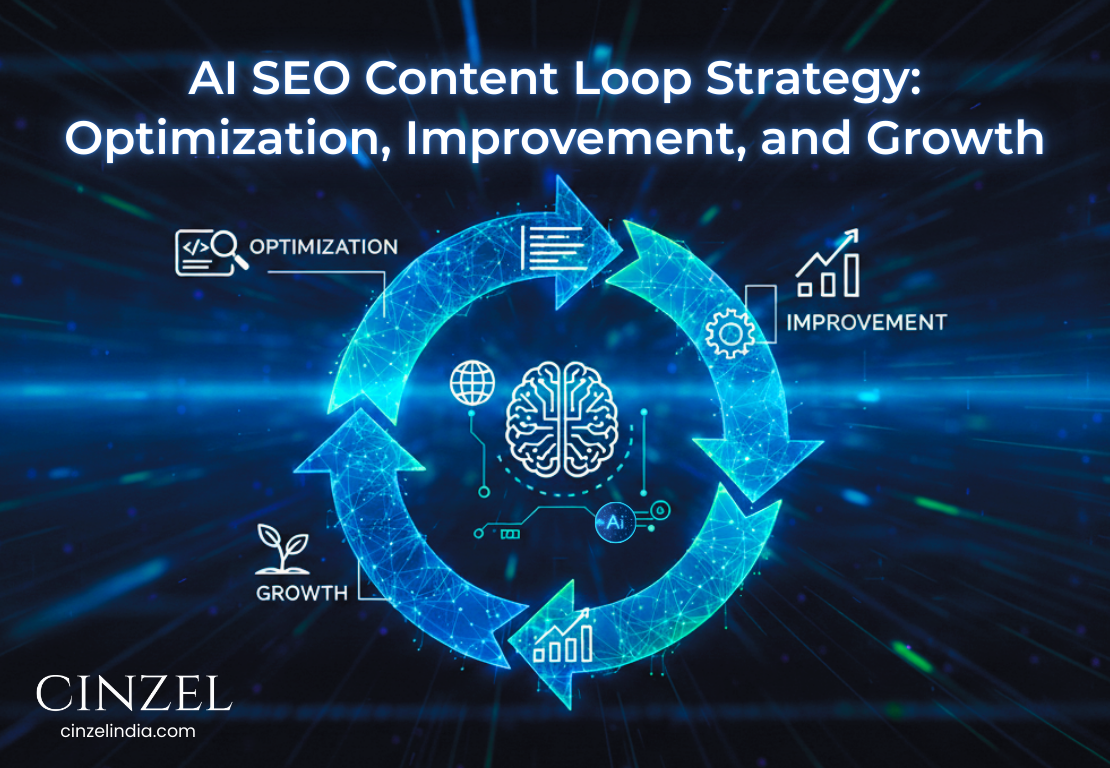
An AI SEO content loop replaces that straight line with a cycle.
You publish content, observe how users and search systems respond, and use those signals to shape what you create next. AI accelerates analysis and optimization, but the principle stays simple:
Let performance guide production.
The Core Stages of a Content Loop
A complete AI SEO content loop includes:
-
-
Research & Planning – Identify real user intent, not just keywords
-
Content Creation – Produce content with AI support and human expertise
-
Publishing & Distribution – Ensure visibility across search and AI platforms
-
Monitoring & Optimization – Analyze engagement and refine content
-
When this cycle is completed consistently, content improves with every iteration — especially when supported by structured content audits.
Why Content Loops Are Critical in 2025
Search behavior has changed dramatically.
AI-generated answers now appear directly in search results for a growing percentage of queries.
Many users get what they need without visiting a single website.
This means:
-
Visibility matters more than clicks
-
Clear answers outperform long explanations
-
Structure is more important than volume
With E-E-A-T expectations evolving toward 2026 and AI-driven ranking signals becoming stronger, static content strategies fall behind quickly.
The Indian Market Adds Another Layer
Indian businesses face additional complexity:
-
-
Multiple languages
-
Regional intent differences
-
City-level behavior shifts
-
Content that resonates in Mumbai may not perform in Delhi.,What works in Bangalore could under perform in Pune.
An AI SEO content loop allows faster testing and adjustment — replacing guesswork with real data.
How to Build an AI SEO Content Loop (Step-by-Step)
Step 1: Build a Research System That Reflects Reality
Start with existing data.
Use Google Search Console to identify:
-
-
Queries already driving impressions
-
Pages ranking without engagement
-
Keywords attracting the wrong audience
-
Then go beyond tools.
Look at:
-
-
Sales conversations
-
Repeated customer questions
-
Support issues
-
AI can accelerate competitor analysis and topic expansion, but human insight determines relevance.
Organize findings in a simple format:
-
-
Target keywords and demand
-
Current ranking pages
-
Content gaps
-
Actual search intent
-
This roadmap becomes crucial when deciding between long-form vs short-form content.
Step 2: Create Content With AI — Without Losing Authority
AI is best used as an assistant, not an author.
Use it to:
-
-
Generate outlines
-
Structure sections
-
Speed up drafting
-
But AI can’t replicate:
-
-
Your business experience
-
Customer interactions
-
Real outcomes and failures
-
That’s where credibility comes from.
Refine AI drafts with:
-
-
Real examples
-
Business-specific data
-
Unique perspectives
-
Short sentences, clean formatting, and bullet points improve readability — and help AI systems interpret content more accurately, especially when using a RAG-based content strategy.
Step 3: Optimize for Every Search Surface
Content must now perform across multiple environments:
-
-
Traditional Google results
-
AI-generated summaries
-
AI platforms like ChatGPT and Perplexity
-
For standard SEO:
-
-
Introduce the main keyword early
-
Use clear, descriptive headings
-
Add internal links
-
Write compelling meta descriptions
-
For AI summaries:
-
-
Answer questions immediately
-
Use direct language
-
Add FAQ sections
-
Implement schema markup
-
You’re writing for deep readers and instant-answer seekers at the same time.
Step 4: Measure What Users Actually Do
Once content is live, performance tracking begins.
Key metrics include:
-
-
Traffic sources
-
Time on page
-
Scroll depth
-
Conversion actions
-
Review weekly during the first month, then monthly.
Focus on patterns — not daily fluctuations.
Engagement differences between topics reveal what truly resonates.
Step 5: Feed Insights Back Into the System
This step defines success — and is where most strategies fail.
After 6–8 weeks, evaluate:
-
-
Which keywords attract qualified visitors
-
Which pages hold attention longest
-
Where users drop off
-
Which content drives actions
-
Winning topics should be expanded.
Underperforming ones should be refined or removed.
This closes the loop — turning performance data into smarter future content.
Real-World Service Business Example
A Delhi-based digital marketing agency tested this approach with five local SEO articles.
One article on Google Business Profile optimization attracted solid traffic but produced no leads.
Another article on local citation management received less traffic — yet generated significantly more consultation requests.
The data was clear.
The agency expanded the citation article into:
-
A comprehensive guide
-
City-specific examples
-
Step-by-step tutorials
Within months, that single page contributed nearly 40% of new client acquisitions.
Without the content loop, they would have scaled the wrong topic.
Common Content Loop Mistakes to Avoid
-
Publishing excessive content without analysis
-
Ignoring performance data
-
AlLowing AI to write without human input
-
Overlooking mobile optimization
-
Skipping the feedback cycle
Five strong, optimized pieces will always outperform fifty average ones.
Making the Content Loop Sustainable
You don’t need intensity — you need consistency.
A practical approach:
-
1–2 quality pieces per month
-
Weekly light performance checks
-
Quarterly content audits
Involve teams:
-
Sales for objections
-
Support for confusion points
-
Product for real usage insights
Over time, your content library becomes sharper, not just larger.
The Way Forward With AI SEO
For any digital marketing agency in Noida focused on long-term growth, the solution lies in moving away from guesswork and toward systems that continuously improve. An AI SEO content loop allows brands to publish with intent, measure what truly works, and refine strategy based on real data instead of assumptions. When content is treated as an evolving asset rather than a one-time task, businesses can achieve stronger visibility, better engagement, and sustainable results in an AI-first search landscape.
