If you run a business anywhere in Delhi NCR — a clinic in Indirapuram, a real estate developer in Greater Noida, or a D2C brand shipping out of Sector 63 — you've probably asked the same question we hear every week: should you invest in SEO or run Google Ads?
Should You Use SEO or Google Ads?
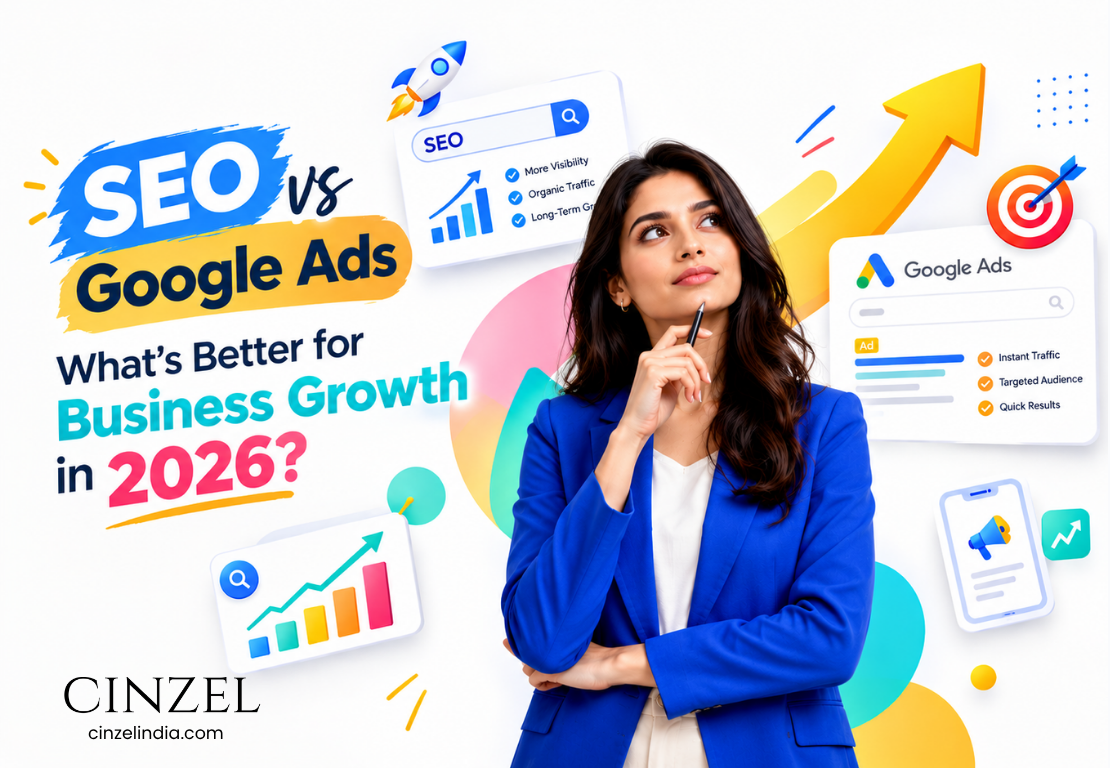
Google Ads delivers traffic and leads within 24–48 hours but stops the moment you stop paying. SEO takes 3–6+ months to build momentum but compounds into a long-term asset that keeps generating leads at a lower cost per lead over time. Most established businesses in Delhi NCR eventually use both — Google Ads for immediate demand, SEO for durable, low-cost visibility.
The honest answer is: it depends on what you need right now. SEO vs Google Ads isn't really a battle with one winner — it's a trade-off between speed and durability, and the right choice changes depending on your budget, your timeline, and how competitive your market is. In this guide, we'll break down SEO vs Google Ads across cost, speed, ROI, long-term growth, scalability, and lead quality, with practical examples and a clear comparison table, so you can make a decision that actually fits your business.
What Is SEO?
Search Engine Optimization (SEO) is the process of improving your website so it ranks organically — without paying per click — for the searches your customers are already making. It covers on-page SEO (content, keywords, headings), technical SEO (site speed, Core Web Vitals, mobile-friendliness), off-page SEO (backlinks, citations, brand mentions), and Local SEO (Google Business Profile, local reviews, "near me" rankings).
SEO in 2026 also means something broader than it did even two years ago. With Google's AI Overviews now appearing on a large share of informational searches and pulling answers from a handful of trusted sources, ranking well isn't just about the traditional blue links anymore — it's also about getting cited as one of those trusted sources. This is where SEO overlaps with AEO (Answer Engine Optimization) and GEO (Generative Engine Optimization), which we'll come back to shortly.
If you're wondering how to rank in AI Overviews, the short answer is: consistent topical authority, clear question-and-answer formatting, and structured data — all of which fall under good AI Overview optimization practice, not a separate discipline from SEO.
What Is Google Ads (PPC)?
Google Ads is a pay-per-click (PPC) advertising platform where you bid to show up at the top of search results, on YouTube, across the Display Network, or inside Performance Max campaigns that run across all of Google's inventory automatically. You pay only when someone clicks (or, for some formats, when they take a specific action), and your ads stop the moment your budget runs out or you pause the campaign.
Google Ads has changed a lot recently too. Manual keyword bidding is no longer the default — most advertisers in 2026 lean on AI-assisted tools like Performance Max and AI Max, which use machine learning to find and bid on the right audience based on the signals, creatives, and goals you feed it. The upside is speed and scale; the trade-off is that you're trusting an algorithm with more of the decision-making than before.
SEO vs Google Ads: The Real Differences
This is the part most business owners actually care about. Let's go factor by factor.
1. Cost
Google Ads has a direct, visible cost: you pay for every click, and costs can range anywhere from roughly ?10 to well over ?150 per click in India depending on your industry, competition, and city. The moment you stop paying, your traffic stops too.
SEO has an indirect cost — you're paying for content, technical work, and link building rather than paying per visitor. Once a page starts ranking well, it can keep bringing in visitors for months or years without an ongoing per-click charge, though it does need periodic updates to stay competitive, especially after Google's core updates (2026 has already seen a March core update and a June spam update reshuffle rankings across many industries).
In short: Google Ads costs money for every visitor, forever. SEO costs money to build, then keeps working with lower ongoing investment.
2. Speed of Results
This is where Google Ads clearly wins. A well-built Google Ads campaign can start sending traffic and leads within 24–48 hours of going live. If you need bookings for a new clinic this month or footfall for a showroom launch this weekend, Google Ads is the faster lever to pull.
SEO takes patience. Depending on competition, a new or moderately competitive page can take 3–6 months to see meaningful movement, and truly competitive keywords in crowded categories (real estate, education, healthcare) can take 6–12 months or longer. This is the single biggest reason business owners get frustrated with SEO — it simply isn't built for urgent, short-term needs.
3. ROI (Return on Investment)
Google Ads ROI is easy to measure but tends to shrink the moment you stop spending — your return exists only while your budget is active. It's also directly proportional: spend more, generally get more (until diminishing returns kick in on saturated keywords).
SEO's ROI compounds. A blog post or service page you invest in today can keep generating leads 12, 24, or even 36 months later at close to zero marginal cost. Over a 2–3 year horizon, most businesses we've worked with see SEO deliver a lower cost per lead than paid ads — but only if they stay consistent long enough to get there.
4. Long-Term Growth
SEO builds an asset. Every optimized page, backlink, and piece of content adds to your website's authority, and that authority compounds — a domain with strong topical authority ranks new content faster than a brand-new site starting from zero. This is exactly why GEO (Generative Engine Optimization) matters in 2026: AI tools like ChatGPT, Gemini, and Google's AI Overviews tend to cite sources that already demonstrate consistent authority on a topic, not one-off pages. Strong SEO today increasingly means better visibility inside AI-generated answers tomorrow.
A solid GEO strategy — structured FAQs, clear summaries, and citation-worthy data points — is quickly becoming as important as traditional keyword optimization for businesses that want to stay visible as search shifts toward AI-generated answers.
Google Ads doesn't build this kind of asset. Pause your campaigns, and your visibility disappears the same day — there's no residual authority carried forward.
5. Scalability
Google Ads scales almost instantly — increase your daily budget and (within reason) your traffic increases with it. This makes it excellent for testing new markets, new products, or seasonal pushes.
SEO scales more slowly because it depends on content production, technical capacity, and the time it takes Google to trust new pages. You can accelerate it with more resources, but you can't simply "increase the budget" and get next-week results the way you can with ads.
6. Lead Generation Quality
Both channels can generate strong leads, but the intent differs. Google Ads is excellent for capturing high-intent, ready-to-buy searches ("emergency plumber Noida," "buy 1.5 ton AC online") and for retargeting people who've already shown interest.
Organic SEO traffic, particularly from informational content and FAQ-style pages, tends to build trust earlier in the buying journey — someone reading your blog on "how to choose a washing machine" today may become a lead in three weeks, not three minutes. Interestingly, several 2026 industry reports note that visitors who click through from AI Overviews or GEO-optimized content convert at noticeably higher rates than average organic traffic, because the AI has already done some of the trust-building work before the click happens.
7. Suitability for Different Businesses
- New businesses with no online presence and an urgent need for leads → Google Ads first, SEO in parallel.
- Established local businesses (clinics, schools, showrooms, real estate) → SEO and Local SEO for durable, low-cost visibility, with Google Ads layered in for peak seasons or urgent campaigns.
- E-commerce and D2C brands → Both, almost always — Google Ads (including Performance Max and Shopping ads) for immediate sales, SEO for category and product pages that keep earning organic traffic long after a sale ends.
- B2B and service businesses with longer sales cycles → SEO-led content marketing tends to outperform ads on cost per qualified lead over time, though ads help fill the pipeline early on.
SEO vs Google Ads: Comparison Table
|
Factor |
SEO |
Google Ads |
|
Cost structure |
Investment in content, technical work, and links; lower ongoing cost |
Pay-per-click; cost continues as long as campaign runs |
|
Speed of results |
3–6+ months typically |
24–48 hours |
|
ROI over time |
Compounds; improves the longer you invest |
Consistent but stops the moment spend stops |
|
Long-term value |
Builds a lasting digital asset (rankings, authority, backlinks) |
No residual value once paused |
|
Scalability |
Slower; depends on content and trust-building |
Fast; scale budget up or down instantly |
|
Best for |
Sustainable, long-term lead generation |
Urgent, short-term, or seasonal lead generation |
|
Control |
High control over content, limited control over ranking speed |
High control over budget, targeting, and timing |
|
Risk if paused |
Rankings usually persist for a while, then gradually decline |
Traffic and leads stop almost immediately |
|
Ideal for |
Local businesses, service providers, content-driven brands |
New launches, product drops, time-sensitive offers |
Practical Examples
Example 1 — A dental clinic in Vaishali: A new clinic with zero online visibility needed patients within the first month of opening. Google Ads (Search campaigns targeting "dentist near me" and "root canal treatment Vaishali") delivered bookings within the first week, while SEO and Local SEO — Google Business Profile optimization, review generation, and location-specific service pages — were built in parallel to reduce dependency on paid spend after month three.
Example 2 — A B2B manufacturing unit in Sector 63: With a long sales cycle and a niche audience, this business found that Google Ads clicks were expensive and often low-intent, since few people search transactionally for industrial components. A content-led SEO strategy — detailed product and application pages targeting specific technical search terms — brought in fewer but far more qualified leads over 6–8 months, at a much lower cost per lead than continued ad spend would have allowed.
Example 3 — A D2C appliance brand: During a festive sale window, Performance Max and Search campaigns drove an immediate spike in sales. At the same time, blog content answering common pre-purchase questions ("inverter vs non-inverter AC," "1.5 ton vs 2 ton AC") kept generating steady, free organic traffic well after the sale ended — traffic the ad budget alone couldn't have sustained.
SEO vs Google Ads: When Should You Choose Which?
Choose SEO if:
- You're building a long-term brand and can invest patiently for 3–6+ months
- Your category has strong informational search demand (guides, comparisons, "how to" content)
- You want to lower your cost per lead over time
- You're a local business that depends on repeat, "near me" style discovery
Choose Google Ads if:
- You need leads or sales within days, not months
- You're launching a new product, offer, or location
- You want precise control over who sees your ads and when
- You're testing a new market before committing long-term budget
Choose both if:
- You want short-term leads and long-term, lower-cost growth (the approach most established businesses eventually land on)
- You're in a competitive category where paid ads fill the gap while SEO authority is being built
- You want to reduce overall customer acquisition cost by blending an immediate channel with a compounding one
In our experience working with businesses across Noida and Delhi NCR, the strongest results almost always come from this blended approach — Google Ads generating leads now, while SEO quietly reduces dependency on paid spend every month that follows.
How a Digital Marketing Agency in Noida Can Help
Deciding between SEO vs Google Ads — or how to combine both — depends heavily on your industry, budget, and competition, and getting it wrong can mean wasted ad spend or months of SEO effort pointed at the wrong keywords. This is usually where working with an experienced team helps.
Cinzel India, a digital marketing agency in Noida (Sector 65, Delhi NCR), works with businesses across categories — including schools, retail and electronics showrooms, and local service providers — on SEO, Google Ads, Meta Ads, social media marketing, and website development. If you're trying to figure out whether SEO, Google Ads, or a combination makes sense for your specific business, Cinzel India can review your goals, budget, and market and recommend a realistic starting point rather than a one-size-fits-all package.
Want a free audit of your SEO and Google Ads strategy? Call +91 9311996381 or visit cinzelindia.com to get started
Businesses searching for the best SEO agency in Noida or the best Google Ads agency in Noida are usually at exactly this decision point — and the right first step is almost always a proper audit before spending on either channel.
Frequently Asked Questions
1.Is SEO better than Google Ads for business growth?
Neither is universally "better" — it depends on your timeline. Google Ads delivers faster results and is better suited to urgent or short-term needs, while SEO builds a long-term asset that lowers your cost per lead over time. Most businesses benefit from using both together.
2.How long does SEO take to show results in India?
Most businesses start seeing measurable movement in rankings and traffic within 3–6 months, with stronger results typically appearing after 6–12 months, depending on competition, current website authority, and content quality.
3.Is Google Ads worth it for small businesses in Noida?
Yes, for businesses that need quick visibility or are testing a new location, product, or offer. Google Ads works well when paired with tight budget control, clear conversion tracking, and Local SEO to reduce long-term ad dependency.
4.Can SEO and Google Ads work together?
Yes, and for most businesses this combination performs better than either channel alone. Google Ads can generate leads immediately while SEO is being built, and search data from ad campaigns can even help identify which keywords are worth prioritizing organically.
5.Which is more cost-effective, SEO or Google Ads?
Google Ads has a predictable but ongoing cost per click. SEO has a higher upfront investment but a lower cost per lead over the long run, since organic traffic doesn't require ongoing per-click spend once a page ranks well.
6.Is SEO or Google Ads better for local businesses in Delhi NCR?
Local SEO — combined with an optimized Google Business Profile — is usually the stronger long-term channel for local businesses, since it builds ongoing visibility for "near me" searches. Google Ads works well alongside it for time-sensitive local offers or new location launches.
7.Do I need a separate agency for SEO and Google Ads, or can one agency handle both?
Many businesses prefer working with a single digital marketing agency in Noida or digital marketing company in Delhi that can manage SEO and Google Ads together, since it allows strategy, budget, and reporting to stay aligned across both channels rather than working in silos.
8.How do I rank in AI Overviews and Google's AI-generated answers?
How to rank in AI Overviews comes down to the same fundamentals as strong SEO, applied more deliberately: clear, structured content (FAQs, comparison tables, summaries), demonstrated topical authority, and a working GEO strategy that makes your content easy for AI tools to cite. Paid ads don't influence AI Overview inclusion — only organic content quality and structure do.
Conclusion: So, What Should You Choose?
There's no single correct answer to SEO vs Google Ads — only the answer that's correct for where your business is right now. If you need leads this week, Google Ads is the faster lever. If you're building a business you plan to run for the next five years, SEO is the investment that keeps paying you back long after you stop actively spending on it.
For most growing businesses in Delhi NCR, the smartest approach isn't choosing one over the other — it's sequencing them well: use Google Ads to generate momentum now, while SEO quietly builds the foundation that reduces how much you'll need to spend on ads a year from now. Whether you handle this in-house or work with a performance marketing agency in Noida or an SEO company in Noida to manage it end-to-end, the goal stays the same — sustainable, predictable growth that doesn't depend entirely on how much you're spending this month.
