
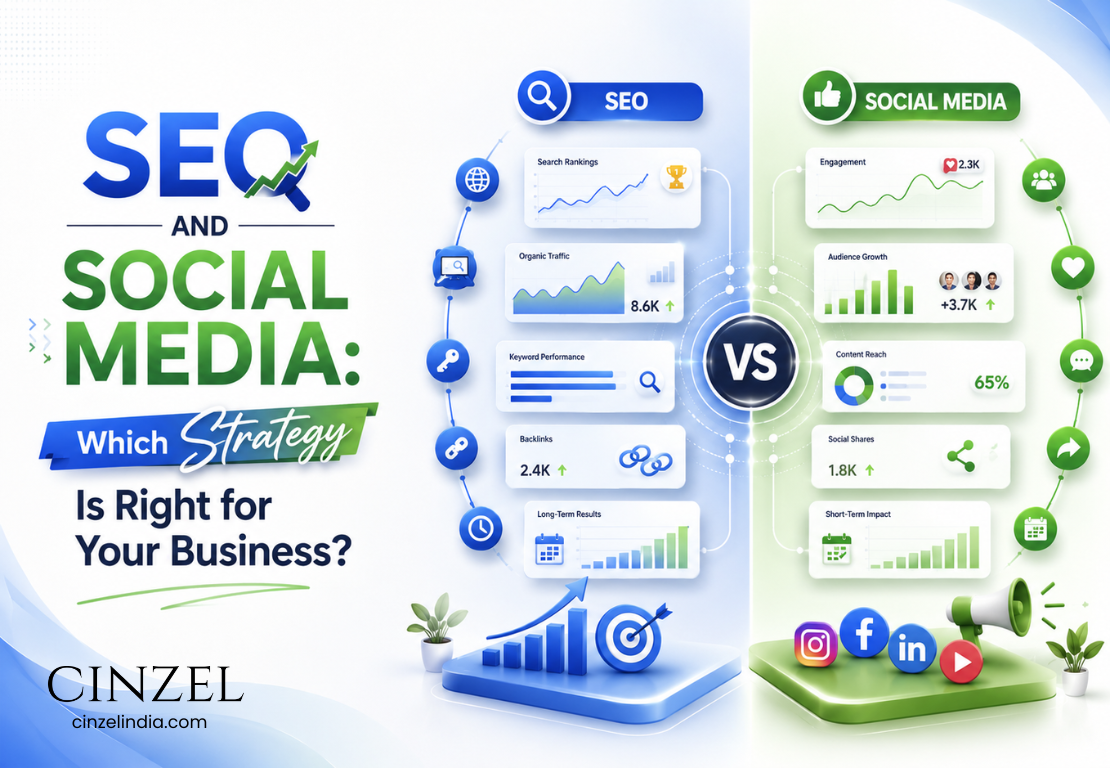
If you run a business today, you have probably asked yourself this question at least once: should I invest in SEO or focus on social media instead? It's one of the most common questions we hear at Cinzel India when new clients walk through our door, and honestly, there's no one-size-fits-all answer.
The truth is, SEO and Social Media are not competitors — they are two different roads that can lead to the same destination: more visibility, more trust, and more customers. But depending on your business type, budget, and goals, one may need to take priority over the other, at least in the short term.
In this guide, we'll break down what SEO and social media marketing actually do, how they're different, when to choose one over the other, and why most businesses eventually need both working together. By the end, you'll have a clear, practical answer for your own business.
What Is SEO and How Does It Work?
Search Engine Optimization (SEO) is the practice of optimizing your website so it ranks higher on search engines like Google when people search for terms related to your business. It's built on three pillars: technical health, quality content, and authority (backlinks and trust signals).
When someone searches "best interior designer near me" or "affordable CRM software for startups," a strong SEO strategy ensures your business shows up in those results — right when the person is actively looking for a solution. That's what makes SEO so powerful for lead generation: you're not interrupting someone's day, you're answering a question they already have. This is also why so many businesses in the NCR region actively search for a Best SEO Agency In Noida — they want a partner who understands both the technical side of rankings and the local competitive landscape.
SEO includes several moving parts:
- On-page SEO — optimizing titles, headings, content, and internal links
- Technical SEO — improving site speed, mobile-friendliness, crawlability, and structured data
- Off-page SEO — earning backlinks and building domain authority
- Local SEO — optimizing for location-based searches, especially important for service businesses with a physical presence or a defined service area
What Is Social Media Marketing?
Social media marketing is exactly what it sounds like — using platforms like Instagram, Facebook, LinkedIn, and YouTube to connect with your audience, build relationships, and promote your brand. Unlike SEO, which is often a slow-and-steady game, social media can generate quick engagement and instant feedback.
A well-planned social media strategy usually involves:
- Consistent content posting (reels, posts, stories)
- Community engagement and replying to comments/DMs
- Paid social ad campaigns
- Influencer collaborations
- Social media management tools to schedule and track performance
Social media is where brand awareness is built. People don't just discover you here — they get to know your personality, your values, and why you're different from competitors.
What Is Social Media SEO?
Social media SEO means optimizing your profiles and posts so people can find you easily through in-app search bars on platforms like Instagram and TikTok, as well as on external search engines like Google. This includes using your main keyword in your username and bio, keeping your business name and links consistent across platforms, writing keyword-rich captions, and adding alt text or captions to your content. As search behavior shifts and more users search directly within social apps, this kind of optimization has become just as important as traditional search engine optimization.
SEO vs Social Media: Key Differences
Here's a simple side-by-side comparison to make things clearer:
|
Factor |
SEO |
Social Media |
|
Time to see results |
3–6 months (long-term) |
Days to weeks (short-term) |
|
Cost over time |
Lower ongoing cost once ranked |
Requires continuous ad spend |
|
Traffic type |
Organic, intent-driven |
Interest-driven, browsing |
|
Longevity |
Long-lasting once ranked |
Content has a short lifespan |
|
Best for |
Search-based discovery |
Relationship building & engagement |
|
Trust factor |
High (users trust search results) |
Builds emotional connection |
Long-Term vs Short-Term Results
|
Aspect |
SEO (Long-Term) |
Social Media (Short-Term) |
|
Growth curve |
Slow start, compounding returns |
Fast start, requires constant fuel |
|
Maintenance |
Periodic content updates |
Daily/weekly content creation |
|
Risk of decline |
Low, if maintained |
High, if posting stops |
|
ROI timeline |
6–12 months for strong ROI |
1–3 months for initial ROI |
Lead Quality Comparison
|
Metric |
SEO Leads |
Social Media Leads |
|
Intent level |
High — user is actively searching |
Varies — often lower initial intent |
|
Conversion rate |
Generally higher |
Generally moderate, improves with retargeting |
|
Cost per lead (long-term) |
Lower over time |
Can be higher without optimization |
|
Nurturing required |
Often less |
Often more (multiple touchpoints) |
Both SEO and Social Media feed into your overall online visibility, but they do it in very different ways. SEO captures people who are already searching for a solution. Social media reaches people who might not even know they need your product yet — but get curious after seeing your content.
When Should You Prioritize SEO?
SEO usually makes more sense first if:
- You run a service-based or local business. If you're a dentist, lawyer, gym, or restaurant, people are actively searching Google for "near me" services. Ranking well means you capture that ready-to-buy intent.
- You want long-term, sustainable growth. SEO compounds over time. A blog post you write today could keep bringing traffic two years from now.
- Your budget is limited. Once you rank, you're not paying per click the way you would with ads. It's one of the most cost-effective digital marketing services in the long run.
- You're targeting a specific city or area. This is where local SEO truly shines — helping businesses appear when someone searches for a "best SEO agency in Noida" or a similar location-based query.
When Should You Prioritize Social Media?
Social media might deserve more of your attention first if:
- You have a visually appealing product. Fashion, food, décor, and lifestyle brands thrive on Instagram and Pinterest because people love to see the product in action.
- You want quick brand recognition. If you just launched and need visibility fast, a strong social media strategy can generate buzz within days.
- You rely on community and trust. Social proof — comments, shares, and reviews — builds credibility quickly, especially for newer brands.
- You want direct, two-way communication with customers. Social platforms let you respond instantly, which builds loyalty.
Why the Smartest Businesses Use Both
Here's something most people miss: SEO and social media actually strengthen each other.
- Social signals support SEO. While social shares aren't a direct Google ranking factor, increased brand searches, backlinks from shared content, and higher website traffic from social platforms all indirectly help your SEO performance.
- SEO content fuels social media. A well-researched blog post can be repurposed into five Instagram carousels, a LinkedIn article, and a YouTube script.
- Social media builds the trust that search engines look for. Google's E-E-A-T guidelines — Experience, Expertise, Authoritativeness, and Trustworthiness — increasingly reward brands with a consistent, credible presence across the web, including social platforms.
- Voice and AI search reward brands with both. With the rise of answer engines and AI-powered search (AEO and GEO), platforms like Google's AI Overviews and ChatGPT often pull from brands that show consistent authority signals across both search and social content.
So instead of asking "SEO or social media," the smarter question is: "What's the right mix for my stage of business?"
Ready to grow your online presence? Get in touch with Cinzel India
today for a free strategy consultation.
How to Decide the Right Mix for Your Business
At Cinzel India, we usually recommend this simple framework to our clients:
Stage 1 — New Business (0–6 months): Focus more on social media to build initial awareness and community. Simultaneously start basic on-page SEO so your website is ready to rank.
Stage 2 — Growing Business (6–18 months): Shift more budget into content marketing and SEO to start capturing organic, intent-driven traffic while continuing consistent social media management.
Stage 3 — Established Business (18+ months): Run both in parallel with roughly equal investment. Use social media data to inform your content marketing calendar, and use SEO insights to guide what topics your audience actually searches for.
This is exactly the kind of integrated approach a good digital marketing agency in Noida should offer — not pushing one channel because it's easier to sell, but building a strategy around what genuinely grows your business.
Conclusion
We're a Noida-based digital marketing agency, and our team has hands-on experience running SEO and Social Media campaigns across industries — from local service businesses to eCommerce brands. What sets us apart is that we don't treat SEO and social media as separate departments. Our strategists collaborate on both, so your content, keywords, and messaging stay consistent everywhere your audience finds you.
If you're searching for the best social media marketing agency in Noida or the best SEO agency in Noida, here's what you can expect when working with us:
- Transparent monthly reporting (no vague "trust the process" promises)
- Custom strategy based on your industry and competitors
- A dedicated content and social media strategy built around your brand voice
- Technical SEO audits and ongoing optimization
- Real experience — our team has managed campaigns for 50+ brands across sectors, giving us the practical, on-ground expertise that search engines and audiences both value
Frequently Asked Questions
1. Is SEO more important than social media?
Neither is inherently "more important" — it depends on your business goals. SEO is better for long-term, intent-driven traffic, while social media excels at fast brand awareness and community building.
2. Can social media replace SEO?
No. Social media posts have a short lifespan and rely on algorithms you don't control. SEO builds a lasting asset — your website — that keeps generating organic traffic over time.
3. How long does SEO take to show results?
Most businesses start seeing meaningful movement in rankings and traffic within 3 to 6 months, depending on competition and website history.
4. Does social media help my SEO ranking directly?
Not directly, but it helps indirectly — through increased brand searches, more website visits, and additional backlink opportunities when your content gets shared.
5. Should a small business in Noida invest in both?
Yes. A local business benefits from local SEO to appear in nearby searches, combined with a social media presence to build trust and stay visible to the local community.
Final Thoughts
SEO vs social media isn't a competition — both work best together. SEO gives you long-term visibility, while social media builds fast, human connections. Businesses that combine both smartly grow the fastest.
At Cinzel India, we're a Noida-based, hands-on team that helps businesses solve exactly this confusion — whether to start with SEO, social media, or both. We've helped brands across industries grow their online visibility with the right strategy.
If you're not sure where to start, Cinzel India can build a clear, custom plan for your business — not a generic template.
